
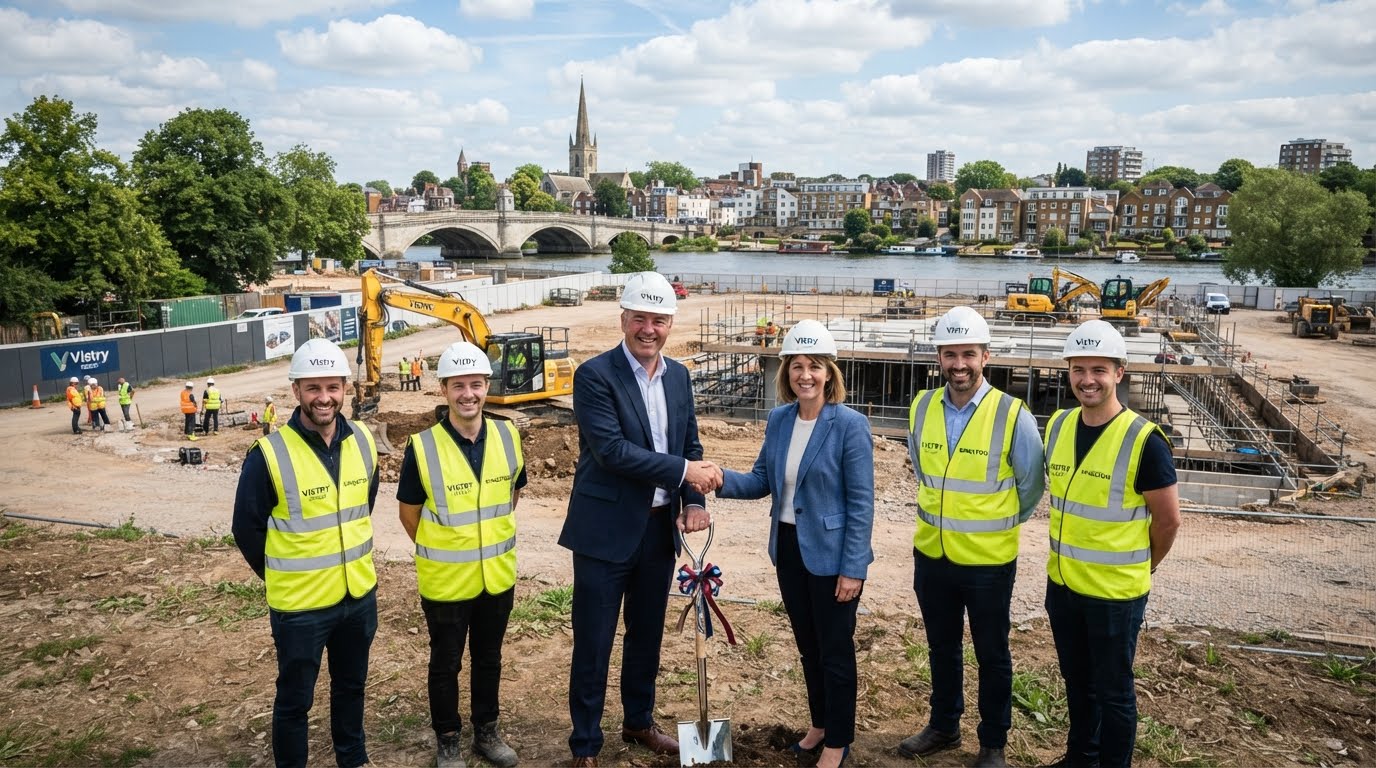
Vistry and Kingston Council have secured approval for phase two of the Cambridge Road Estate regeneration in south‑west London, a scheme that will deliver 2,170 new homes in total.
The approved stage covers 383 new homes, of which 94 — 25% — will be for council rent. Designed by architect BPTW, the plans include more than 700 cycle spaces, around 120 parking spaces, around 100 new trees, and over 2,000 square metres of play space. The permission follows completion of 250 homes in phase one, with a further 202 units and a new community centre currently under construction.
The wider masterplan
The wider project, delivered over 12 years, was granted hybrid planning consent in 2022. It will provide a mix of council rent, shared ownership, and market sale homes. The affordable housing component — 25% at council rent — is higher than most private‑led schemes deliver, which reflects the council’s role as a joint venture partner rather than a regulator.
The scheme replaces an existing 1960s estate with higher‑density, better‑insulated housing. The design approach emphasises pedestrian and cycle connectivity over car access, which is consistent with the Greater London Authority’s broader transport strategy.
A rare approval in a difficult market
The approval stands in contrast to the wave of pauses elsewhere in the capital. British Land has halted phase two of Canada Water, and Landsec has stepped back from Lewisham — both citing viability.
Vistry’s scheme demonstrates that public‑private partnership structures, with a defined affordable housing component and a phased delivery model, can still unlock large‑scale regeneration in a difficult market. The council’s land ownership, its willingness to accept a longer delivery timeline, and the phased sale approach all reduce the risk profile compared with a single‑phase speculative development.
What this means for the London pipeline
The pipeline for large London schemes is thinning. The developments that proceed will increasingly rely on council partnerships, grant funding, and mixed‑tenure models rather than pure market sale. Investors and contractors should track planning committees and viability assessments, not just headline land values.
For contractors, the opportunity is in phased delivery — schemes that can be built in stages, with the affordable housing component delivered alongside market sale units rather than deferred to the end. That structure is more resilient to market swings, because it does not depend on the final sales value of the entire scheme to justify the whole investment.
The Cambridge Road Estate is likely to be watched closely as a template. If it delivers on its timetable and its affordable housing commitments, it will support the case for similar public‑private models elsewhere in London. If it stalls, it will reinforce the argument that even partnership structures cannot overcome the current viability gap.

0 Comments
No comments yet. Be the first to share your thoughts.