
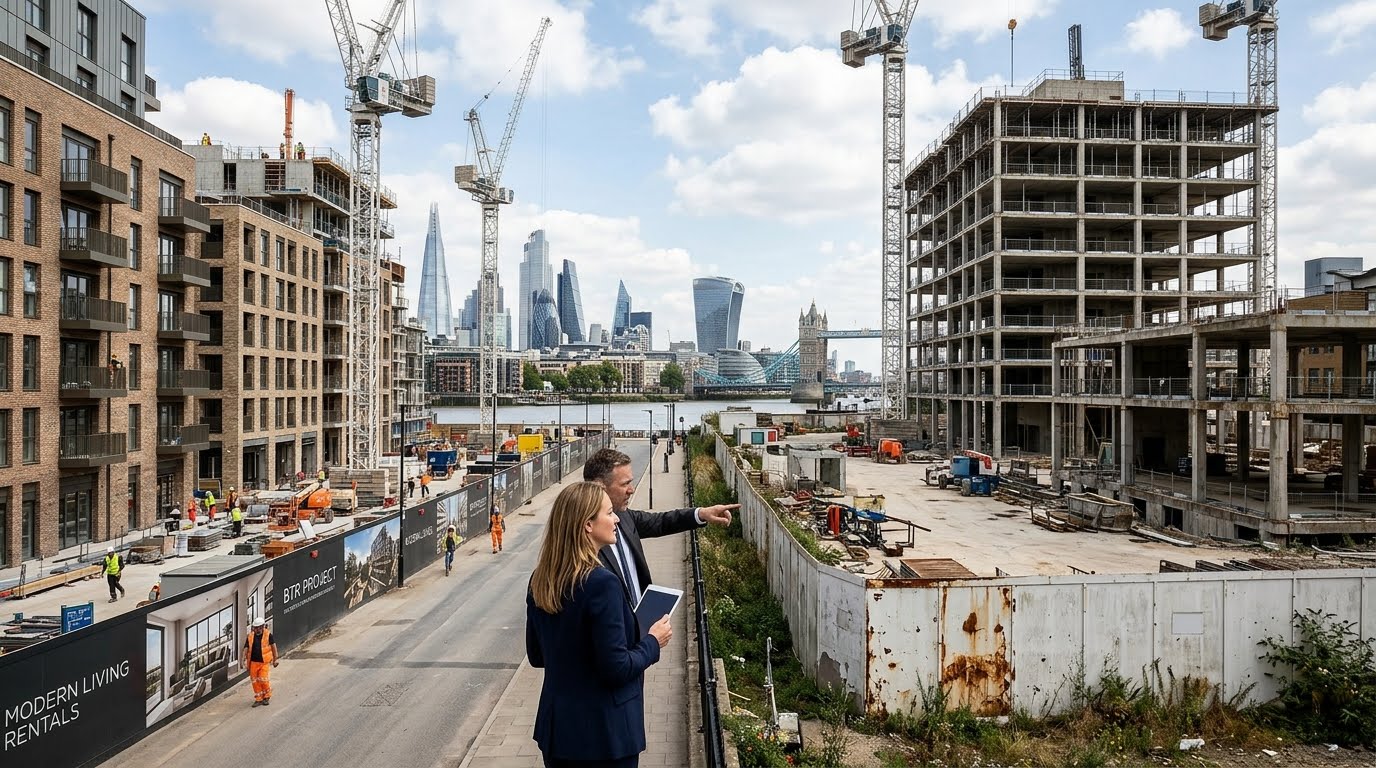
Two contrasting signals define the investment market this month. On one side, Knight Frank reports that UK build‑to‑rent investment has reached £4.2bn so far in 2026 — a headline positive for a sector benefiting from a structurally imbalanced housing market. BNP Paribas’ Q3 update notes that the single‑family rental sector accounted for the greater share of investment activity in the quarter.
On the other, British Land has paused the second phase of its £4bn Canada Water scheme — a 3,700‑home project in south‑east London — citing persistently high regulatory, material, and labour costs, plus slow sales of the 265 homes already completed in phase one. The developer is not alone: Landsec has “de‑prioritised” its 2,800‑home Lewisham shopping centre redevelopment, and Taylor Wimpey’s chief executive has described the London viability environment as “fundamentally broken”.
Two different markets
The apparent contradiction resolves once you separate the two asset classes. Institutional capital is flowing into build‑to‑rent and single‑family rental because the rental market’s supply‑demand imbalance supports rental income growth, and because operational assets are valued on income rather than on exit price.
Speculative for‑sale development in London is stalling because build costs and mortgage rates have eroded margins. The economics of a for‑sale scheme depend on the sale price achieved at completion; the economics of a BTR scheme depend on the stabilised rent roll and the yield at which it can be sold to an institutional buyer.
That distinction matters enormously for investors evaluating exposure to the sector. A fund investing in stabilised BTR assets with long‑term income is buying a very different risk profile from a fund investing in land and development finance.
Where the capital is going?
The BTR investment numbers show clear geographic and typological preferences. Single‑family rental — houses rather than flats — is taking a larger share of investment activity because it aligns with the strongest tenant demand: families who want space, gardens, and proximity to good schools.
Regional cities continue to attract capital. Manchester, Leeds, Birmingham, and Bristol have all seen significant BTR activity in 2026, driven by strong graduate retention, employment growth, and lower land costs than London.
Implications for the London pipeline
The London pipeline is thinning. Schemes that proceed will increasingly rely on council partnerships, grant funding, and mixed‑tenure models rather than pure market sale. Investors and contractors should track planning committees and viability assessments, not just headline land values.
For landlords and small investors, the BTR story is less about direct investment and more about competitive dynamics. As institutional BTR stock comes online, it will put pressure on older private rental stock that cannot match the amenities — concierge, gyms, co‑working space — that purpose‑built schemes offer. Landlords who compete on price alone will find themselves in an increasingly difficult position.

0 Comments
No comments yet. Be the first to share your thoughts.